


Banks And Industrial Finance In Britain 1800-1939
Publisher: Macmillan
Format: Paperback
ISBN: 9780333491522
Banks and Industrial Finance in Britain 1800–1939 (1991) – Michael Collins
Macmillan | ISBN: 9780333491522
Condition: Good | Sold by Crappy Old Books
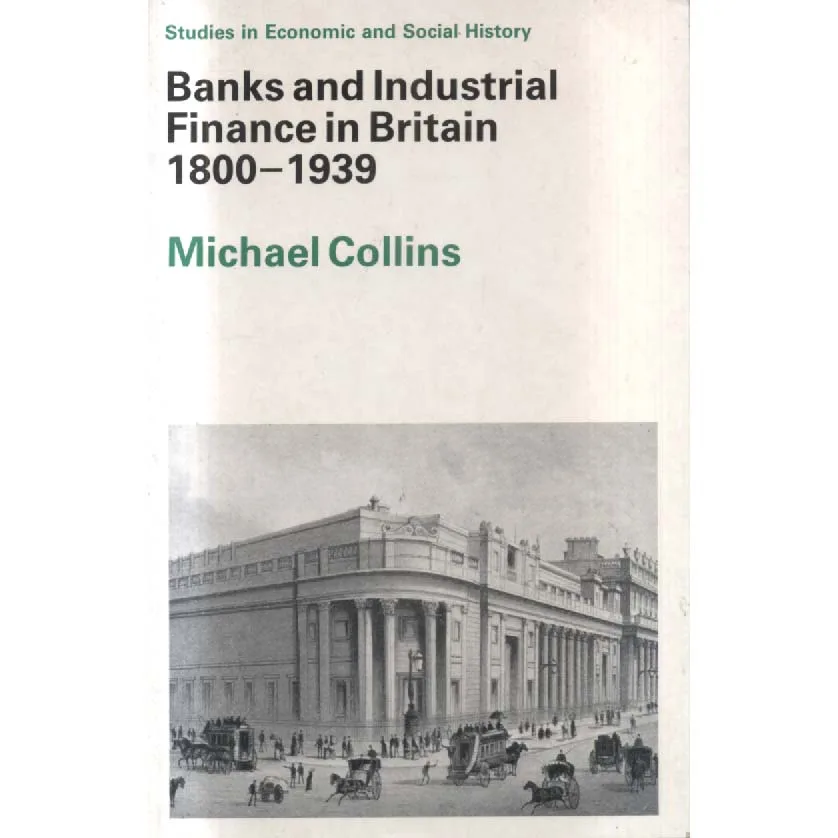
Bankers. Those reassuringly serious individuals who spend their professional lives deciding whether other people should be allowed to borrow money, usually while occupying substantial buildings designed to suggest that the institution is considerably wealthier, wiser and more permanent than its customers. For centuries, British bankers have exercised enormous influence over the nation’s economic fortunes, although their enthusiasm for financing industrial progress has not always matched the ambitions of the people actually trying to manufacture something.
In Banks and Industrial Finance in Britain 1800–1939, economic historian Michael Collins examines the relationship between Britain’s banking system and its industrial development during a period that saw the country rise to become the world’s leading manufacturing power, before discovering that maintaining this enviable position was rather more difficult than achieving it.
The story begins in the nineteenth century, when steam engines, cotton mills, ironworks and railways were transforming the British economy at a speed that would have astonished earlier generations. Industrialists required capital, banks possessed money, and one might reasonably assume that bringing the two together would be perfectly straightforward.
Naturally, economics seldom rewards reasonable assumptions.
British banks developed distinctive traditions of lending, liquidity management and financial conservatism. Their preference for relatively short-term commercial credit has frequently been contrasted with the supposedly more adventurous industrial financing arrangements found elsewhere, particularly in Germany.
But were British bankers genuinely responsible for holding back industrial development? Did they neglect promising manufacturers while concentrating upon safer and more respectable financial activities? Or have generations of critics unfairly blamed the banks for deeper problems within British industry?
Collins investigates these questions through the historical development of banking institutions, industrial investment and the changing financial requirements of British businesses. His study explores the complex relationships between lenders and borrowers, questioning simplified explanations of Britain’s economic successes and subsequent industrial difficulties.
The period covered includes the expansion of joint-stock banking, the growing concentration of financial institutions, the challenges of international competition and the considerable economic disruption caused by the First World War and the Great Depression.
Throughout, the underlying problem remains wonderfully familiar: businesses need money to expand, banks want their loans repaid, and neither party is entirely convinced that the other understands the realities of commercial life.
Published in 1991 by Macmillan, this scholarly volume offers a valuable contribution to British economic and financial history, particularly the longstanding debate surrounding the relationship between the City of London and the nation’s manufacturing industries.
This Good-condition copy, offered by Crappy Old Books, will appeal to economic historians, banking researchers, students of industrialisation and anyone interested in understanding how Britain’s financial institutions helped shape, or occasionally complicated, the country’s economic development.
An illuminating examination of nearly a century and a half of industrial ambition, financial caution and the eternal struggle to persuade somebody with money to lend it to somebody with an idea.
Because while Britain may have invented the modern industrial economy, its bankers still wanted to know precisely when they could expect their money back.
Preferably with interest.
Keep browsing: See more History books Other books by Michael Collins
